
Along the back
The fixed part, running along the spine from the base of the neck to the leash ring. It is not adjustable, which is why it drives the choice.
Haqihana
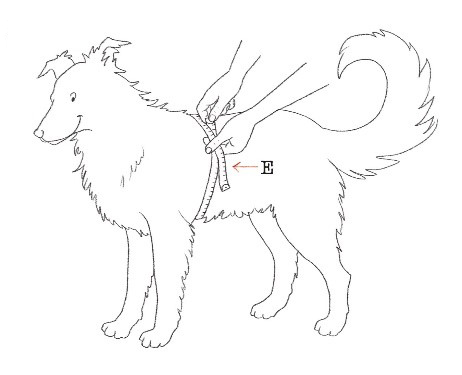
One measurement decides almost everything: the chest circumference, taken just behind the front legs. Everything else on this page helps you settle between the two sizes it will suggest.
Go straight to the calculator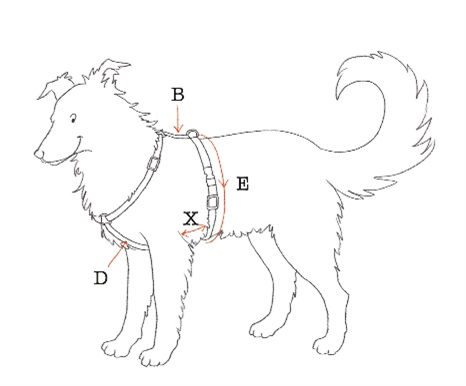
Pass the tape just behind the front legs, around the deepest part of the ribcage. Keep it snug without compressing the coat.
This single figure narrows the choice to two or three sizes, one of which is usually a Long version.
At 72 cm, the table points to these sizes. Notice that several are possible: that is normal, and the rest of the page is about choosing between them.
| Size | Chest circumference | Strap B, back | Strap D, sternum |
|---|---|---|---|
| S | 50–75 cm | 11,5 cm | 14-22 cm |
| SL long version | 50–75 cm | 13,5 cm | 17-28 cm |
| S2H | 50–75 cm | 13,5 cm | 10,5-17 cm |
| M | 60–90 cm | 13,5 cm | 17-28 cm |
| ML long version | 60–90 cm | 16,5 cm | 20-33 cm |
| M2H | 60–90 cm | 16,5 cm | 15,5-25 cm |
| L2H | 70–110 cm | 20 cm | 23-40 cm |
Here, the dog could wear a size S almost fully extended, or a size M almost fully tightened.
It is not a strict rule, but we usually suggest the larger size: it leaves room for a little weight gain, for the strap shrinking over time by roughly 7 percent, and for a winter coat underneath.
Some owners prefer the smaller size because it is lighter. For this dog, we chose the M.
For the same chest circumference, the table often suggests a Long version too, ML next to M for instance. The Long sizes exist to give the shoulder blade room to move: they keep the strap away from the armpits.
Two measurements decide, B and D, both listed in the table above.
The fixed part, running along the spine from the base of the neck to the leash ring. It is not adjustable, which is why it drives the choice.
The adjustable part, running down the breastbone. It absorbs the differences between two dogs of the same chest size.
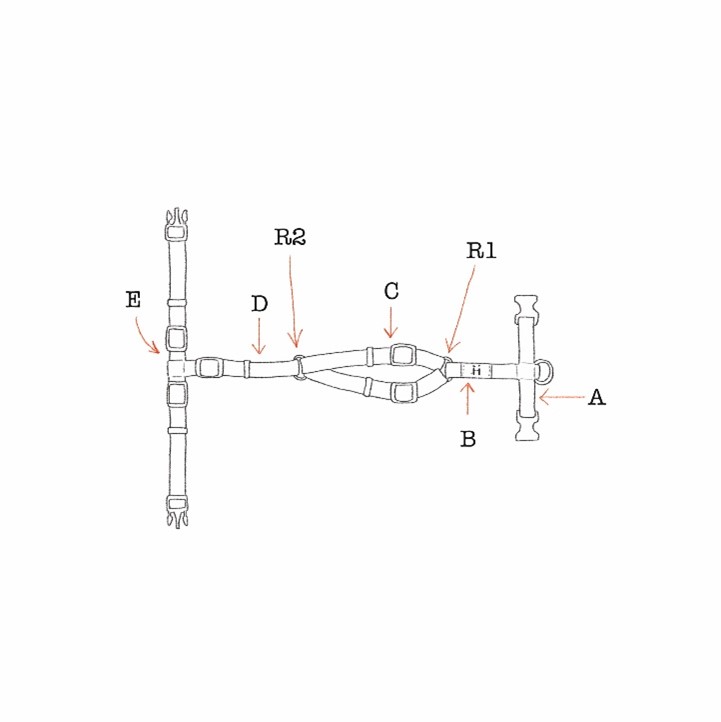
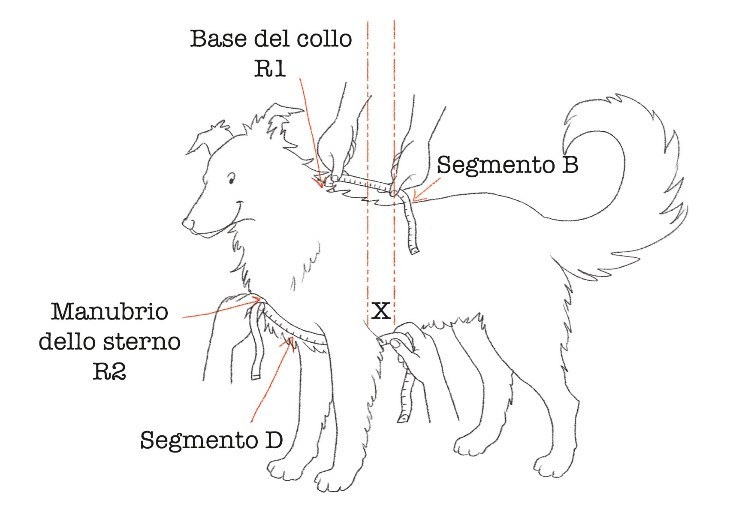
The landmark to check. Ring R1 sits at the base of the neck, between the shoulder blades. Ring R2 sits at the tip of the sternum. With B and D chosen correctly, strap E stays clear of the armpits and shoulder blades, about four fingers away.
The Long version suits long-bodied dogs, corgis and dachshunds first of all, but it works for any elongated build.
The complete range. These are the same figures the calculator below uses.
| Size | Chest circumference | Strap B, back | Strap D, sternum |
|---|---|---|---|
| XXXS | 30–40 cm | 7,5 cm | 7-9,5 cm |
| XXS | 33–45 cm | 7 cm | 8,5-11 cm |
| XXSL long version | 33–45 cm | 8,5 cm | 10,5-16 cm |
| XS | 40–55 cm | 8,5 cm | 10,5-16 cm |
| XSL long version | 40–55 cm | 11,5 cm | 14-22 cm |
| S | 50–75 cm | 11,5 cm | 14-22 cm |
| SL long version | 50–75 cm | 13,5 cm | 17-28 cm |
| S2H | 50–75 cm | 13,5 cm | 10,5-17 cm |
| M | 60–90 cm | 13,5 cm | 17-28 cm |
| ML long version | 60–90 cm | 16,5 cm | 20-33 cm |
| M2H | 60–90 cm | 16,5 cm | 15,5-25 cm |
| L | 75–110 cm | 16,5 cm | 20-33 cm |
| L2H | 70–110 cm | 20 cm | 23-40 cm |
| XL | 85–130 cm | 20 cm | 23-40 cm |
Enter the chest measurement and it returns the matching sizes, with their B and D lengths.